

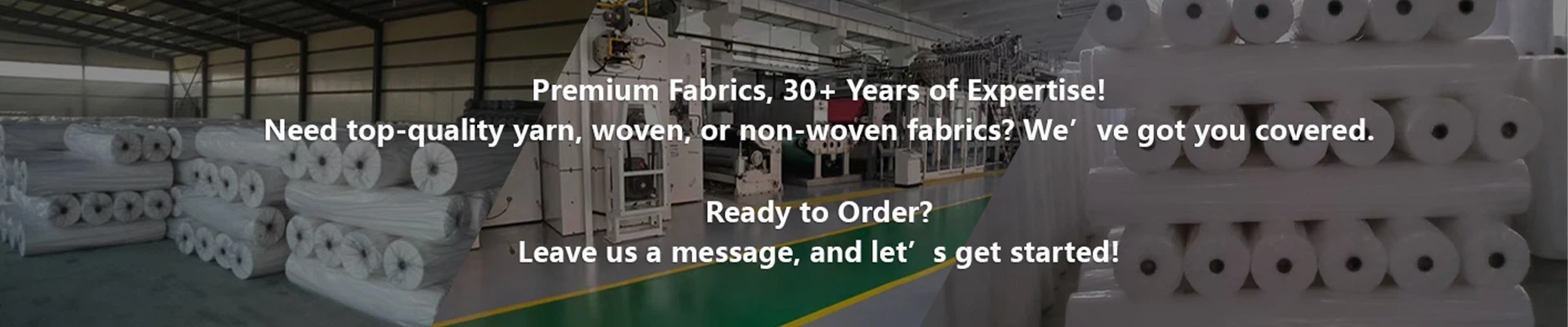
Our company was founded in 1999. The founder, Mr. Jia, has engaged in textiles for more than 30 years. The whole chain of textiles, the range from cotton purchase, spinning, weaving, to final product-garments, are all dabbled. This company was established initially committed to export fabrics, then expanded cotton yarn import and garment export business step by step. After so many years of accumulation, we have the stable suppliers and clients. Our operation principle is quality-oriented, customer first and the supremacy of credibility. Welcome to negotiate with us for a long-term and win-win business cooperation ralations.
-

Nonwoven bags are indispensable product in the life, which can significantly help reduce the use of disposable plastic bags. As an eco-friendly material, it not only reduces environmental pollution
Add to Inquiry -
Nonwoven Fabric For Sanitary Napkins
In sanitary napkins, nonwoven fabrics are mainly applied to the surface, where it directly touches the skin. Therefore, choosing the appropriate material is essential, as it keeps the skin dry,
Add to Inquiry -
Facial mask paper is a popular skincare option in our daily routine. The market offers a wide variety of facial mask papers, while our company specializes in producing and selling those made from
Add to Inquiry -
Industrial Wipe Nonwoven Fabric
Industrial wipe nonwoven fabric is an advanced cleaning solution crafted for industrial settings, predominantly composed of wood pulp polyester or wood pulp polypropylene (PP). Both types share the
Add to Inquiry -
Whenever we travel or go on a business trip, we often encounter inconveniences due to the size and weight of traditional towels, and the problem of bacterial breeding can also make us headaches.
Add to Inquiry -
Disposable Bedding Set For Travel
We often have to stay in a hotel for business trip or travel, and many of us worry about the pillowcases, duvet cover and bed sheet in the hotel whether clean or hygienic. Disposable bedding sets can
Add to Inquiry -
Disposable Compressed Bath Towel
Disposable compressed bath towel is one of the common necessities people have when traveling, camping or swimming. Each piece of bath towel is compressed into a small disc, taking up very little
Add to Inquiry -
Disposable Compressed Face Towel
Disposable compressed face towel is a must-have for home or travel. Compared with traditional towel, it has dual advantages. One of them is portability. Each piece of face towel is compressed and
Add to Inquiry -
Disposable face towels, crafted from soft pure cotton fibers, offer numerous notable benefits. Pure cotton fibers exhibit excellent water absorption, swiftly drawing moisture from the skin to keep it
Add to Inquiry -
Disposable Floor Cleaning Wipes
Disposable floor cleaning wipes are an extremely convenient cleaning product designed specifically to simplify the process of cleaning floors. Their exceptional performance makes them a top choice
Add to Inquiry -
Disposable Kitchen Cleaning Cloths
Disposable kitchen cleaning cloths is a nonwoven fabric used for household hygiene cleaning, it can be made with viscose, cotton, polyester, polypropylene and wood pulp fiber, each material has its
Add to Inquiry -
Flushable nonwoven fabric, made from Lyocell and wood pulp fibers, is a green and efficient cleaning material. Lyocell fibers, renowned for their durability and moisture-wicking properties, are
Add to Inquiry


Why Choose Us
Quality Control
Our operation principle is quality-oriented, customer first and the supremacy of credibility. Welcome to negotiate with us for a long-term and win-win business cooperation ralations.
Factory
Our company was founded in 1999. The founder, Mr. Jia, has engaged in textiles for more than 30 years.
Rich Experience
We can provide our suggestion based on our experience once you need.We have inspector team with many years experience.
Professional Team
We can offer new product development assistance on our strength, regional advantage and full supply chain. We used to export printed plastic zip lock bags, printed board, shopping bags etc. at the request of clients.
Nonwovens or nonwoven fabrics are fabrics that are produced by mechanical, thermal or chemical processes, but without being woven and without the need to convert fibers into yarn, since the fiber webs are bonded together as a result of the inherent friction (entanglement) from one fiber to another thanks to these non-conventional processes.
To form the nonwoven fabric, textile fibers are randomly dumped into a tray without any one direction needing to predominate and are bonded to each other by mechanical, chemical or heat means in the form of webs, mats or sheets. Nonwoven fabrics are made mainly from polymers, are inexpensive, have high strength and are commonly used for plastics.
Benefits of NonWoven Fabrics
Versatility:
Nonwoven fabrics are incredibly versatile, with a wide range of types catering to diverse applications. Their properties can be tailored to suit specific needs, making them suitable for industries as varied as healthcare, agriculture, automotive, and fashion.
Enhanced Properties:
Different types of nonwoven fabrics possess unique properties that set them apart. For instance, spunbond nonwoven fabric offers high tensile strength and dimensional stability, while meltblown fabrics exhibit exceptional filtration capabilities. These specialised properties make nonwoven fabrics suitable for specific applications where these traits are crucial.
Eco-Friendliness:
As sustainability becomes a central concern, nonwoven fabrics have gained attention for their eco-friendly attributes. Many nonwoven fabrics are recyclable and can be repurposed for other applications. Nonwoven fabric bags, for example, have become a popular alternative to single-use plastic bags, contributing to reduced plastic waste.
Ease of Production:
Nonwoven fabrics can be produced relatively quickly using automated machinery. This efficiency in production translates to shorter lead times and quicker response to market demands. The ability to rapidly adapt to changing requirements is a significant advantage in industries with dynamic needs.
Type of NonWoven Fabric
Spun-lace nonwoven fabrics
Spun-lace technology involves spraying high-pressure fine water onto one or more layers of a fiber network to tangle the fibers together and reinforce them with strength.
Heat nonwoven fabrics
A fiber-like structure is added to a web or hot powder melt adhesive reinforcing material, then heated, melted, and cooled to form a cloth.
Wet nonwoven fabrics
Wet nonwoven cloth is a fiber material placed in an aqueous medium and opened into a single fiber while mixing different fiber raw materials, making a fiber suspension slurry, suspended pulp transferred into the body. The fibers are re-laid into cloth in wet condition.
Spun-bond nonwoven fabrics
After the polymer has been extruded and stretched to form a continuous filament, the web is passed via its bonding, thermal bonding, chemical bonding, or mechanical reinforcing. The fiber can be converted into a nonwoven fabric cloth.
Melt blown cloth nonwoven fabrics
Polymer feedmelt extrusionfiber formation, fiber cooling into the network reinforced into cloth is the procedure for melt-blown cloth materials.
Personal care and hygiene
Baby diapers, feminine hygiene products, adult incontinence items, dry and wet pads, nursing pads, nasal strips, bandages, and wound dressings.
Clothing
Interlinings, insulation, protective clothing, industrial workwear, chemical defense suits, shoe components, etc.
Home
Wipes and dusters, tea and coffee bags, fabric softeners, food wraps, filters, bed, table linen, etc.
Automotive
Boot liners, shelf trim, oil, cabin air filters, molded bonnet liners, heat shields, airbags, tapes, decorative fabrics, etc.
Construction
Roofing and tile underlay, thermal and noise insulation, house wrap, understanding, drainage, etc.
Filtration
HEPA, ULPA filters, gasoline, oil, air filters, water, coffee, tea bags, liquid cartridge, bag filters, vacuum bags, allergen membranes, or laminates with nonwoven layers.
Industrial
Cable insulation, abrasives, reinforced plastics, battery separators, satellite dishes, artificial leather, air conditioning, and coating.
Nonwoven fabric manufacturing is a complex and intricate process that involves a number of steps. The process begins with the selection of raw materials, which are then passed through a series of machines that perform various operations to convert them into finished products.
The nonwoven fabric manufacturing process is carried out in two main stages: the spinning stage and the finishing stage. In the spinning stage, the raw materials are converted into yarn, which is then used to weave the fabric. In the finishing stage, the fabric is given its final shape and properties.
Raw Materials Selection
The primary raw materials used in nonwoven fabric manufacturing include fibers such as polyester, polypropylene, nylon, and rayon. These fibers are selected based on their properties such as strength, color, and texture.
Preparation
The fibers are first cleaned and made free from any impurities. The fiber is then processed into smaller filaments through mechanical methods such as carding or combing. Alternatively, synthetic fibers are melted and extruded as fine threads.
Web Formation
The next step involves the formation of a web from the prepared fibers. This can be done through various techniques such as air laying, carding, or spunbonding.
Air Laying – The fibers are blown through a nozzle and deposited onto a conveyor. This technique allows the fibers to be deposited uniformly and randomly.
Carding – The fibers are placed through a series of rollers which separate and align the fibers into a web.
Spunbond – In this process, molten polymer material is extruded to form continuous filaments. The filaments are then laid on a conveyor belt and bonded together with heat and pressure.
Bonding
Once the web is formed, it must be bonded together. This is done through various techniques such as thermal, mechanical or chemical bonding.
Thermal Bonding – In this process, heat is used to melt the fibers and bond them together.
Mechanical Bonding – In this process, the fibers are mechanically entangled with each other through needles or water jets. This technique results in a stronger and more durable fabric.
Chemical Bonding – In this process, chemicals are used to bond the fibers together at a molecular level.
Finishing
After bonding, the fabric is given its final properties such as strength, water resistance, or fire resistance. The fabric may also be treated with dyes or coatings to improve its appearance or functionality.
Cutting and Packaging
The final step involves cutting the fabric according to the desired size and packaging it for shipment.The nonwoven fabric manufacturing process is a complex and automated process that requires specialized equipment, skilled labor, and a thorough understanding of the properties of different materials. Nonwoven fabrics have wide applications in various industries due to their unique properties such as lightweight, durability, and water resistance.
How to Maintain NonWoven Fabrics
Nonwoven fabric is a new type of environmental protection material in recent years. It has many advantages, such as moisture-proof, breathable, non-toxic, non-irritating, low price and so on. It uses polypropylene (pp material) pellets as raw materials and is melted at high temperature. , Spinning, spreading, hot-pressing coiling and continuous one-step production. It is called cloth because of its appearance and certain properties.
Keep it clean to avoid the breeding of moths.
Pay attention to shading to prevent fading. It should be ventilated frequently, dust and damp, not exposed to the sun. Anti-mold and anti-moth tablets should be placed in the wardrobe to prevent the cashmere products from being damp and moldy.
The lining of the matching outerwear should be smooth when worn inside, and hard objects such as pens, key cases, mobile phones, etc. should not be placed in the pockets to avoid local friction and pilling. Minimize friction with hard objects (such as sofa backrests, armrests, tabletops) and hooks when worn outside. Wearing time is not easy to be too long. It must be stopped or changed for about 5 days to restore the elasticity of the clothes to avoid fiber fatigue and damage.
If there is a pilling, do not pull it forcefully. Use scissors to cut the pompon to avoid being unable to repair due to the thread being off.

Comparison of Woven and NonWoven Fabrics
Comparing woven and nonwoven fabrics shows the distinct differences in their texture and construction. Woven fabrics are made by interlacing two sets of yarns at right angles to each other. This creates a strong, durable, and flexible fabric that can be used for a variety of applications.
On the other hand, nonwoven fabrics are made by bonding or felting together fibers. This process creates a fabric that is often softer and more pliable than woven fabrics.
Texture: Woven fabrics have a visible texture that is created by the interlacing of yarns. This texture can range from smooth and flat to rough and bumpy, depending on the type of weave used. Nonwoven fabrics, on the other hand, have a more uniform texture that is created by the bonding or felting process. They’re often softer and more flexible than woven fabrics.
Strength: Woven fabrics are generally stronger and more durable than nonwoven fabrics. This is because the interlacing of yarns creates a strong, flexible structure that can withstand wear and tear. Nonwoven fabrics are often used for disposable applications because they’re not as strong or durable as woven fabrics.
Manufacturing process: Woven fabrics are typically made on a loom, where the yarns are interlaced to create the desired pattern. This process can be time-consuming and labor-intensive. Nonwoven fabrics, on the other hand, are made using a variety of processes, including bonding, felting, and spunbonding. These processes are often faster and more efficient than weaving.
Our Factory
Our company was founded in 1999. The founder, Mr. Jia, has engaged in textiles for more than 30 years. The whole chain of textiles, the range from cotton purchase, spinning, weaving, to final product-garments, are all dabbled.

FAQ
As one of the leading nonwoven fabrics suppliers in China for over 20 years, we warmly welcome you to buy or wholesale nonwoven fabrics for sale here from our factory. All customized products are with high quality and competitive price. Contact us for quotation and free sample.
Non woven Fabric for Cleaning, Non woven Fabrics, Wood Pulp Spunlace Non woven Fabric