How do we identify clothing fabrics?
Feb 06, 2024
In daily life, every one of us cannot do without clothing, but many people have a superficial understanding of fabrics, and sometimes the clothes bought with a lot of money become useless after being worn a few times.
There are two effective methods for identifying fabrics: One is the sensory method, and the other is the label recognition method. The sensory method requires some experience, but it is not difficult to achieve, as long as you intentionally touch various fabrics while shopping, over time, you will gain something.
Identification of silk and rayon through sensory method:
1.Silk has a soft and elastic texture, and feels cool when gently rubbed. The texture of rayon is relatively rough and hard, with a damp and cold feeling.
2.Silk has a softer luster, bright and not dazzling. The luster of rayon is similar to that of metal.
3.Grasp the fabric tightly before releasing it, as the wrinkles in silk are less than those in rayon.
4.Dropping water onto the fabric and rubbing it, the rayon can easily break, while silk is more durable.
Distinguish various fibers through sensory methods:
Cotton. Cotton is thin and soft, with low elasticity and easy to wrinkle.
Hemp. The hemp has a rough and hard texture, often with defects.
Silk. The silk is shiny, soft and lightweight, with a rustling sound when pinched, giving off a cool feeling.
Wool. Wool is elastic, has a soft luster, warm to the touch, and not easy to wrinkle.
Polyester. Polyester has good elasticity, smoothness, high strength, firmness, and a cool feeling.
Nylon. Nylon is not easy to break, elastic, smooth, lightweight, and not as soft as silk.
Vinylon. Vinylon is similar to cotton, with a dull luster and not as soft as cotton. It has poor resilience and is prone to wrinkles.
Acrylic. Acrylic fiber has good warmth retention, high strength, is lighter than cotton, and has a soft and fluffy feeling.
Viscose fabric. Viscose fibers are softer than cotton fibers, and have a stronger surface gloss than cotton, but the fastness is poor.
Pure cotton fabric is a textile made from cotton as raw material, interwoven by warp and weft yarns in a weaving machine.
Pure cotton fabrics are divided into:
① Natural white fabric: ordinary fabric, muslin fabric, coarse fabric, canvas, twill grey fabric, and original color fabric.
② Color cloth: vulcanized blue cloth, vulcanized ink cloth, Shilin blue cloth, Shilin gray cloth, and colored poplin.
③ Flower cloth: It is a fabric that printed and dyed with various colors and patterns. Such as plain printed fabric, printed twill fabric, printed serge, printed tribute.
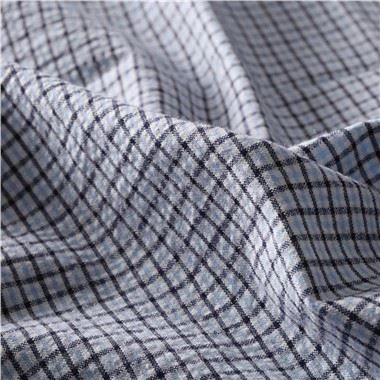
④ Yarn dyed fabric: It is a fabric made by dyeing yarn or thread first, and then weaving it on a machine, such as plaid, duvet, velvet, decorative fabric, etc.
The characteristics of pure cotton fabrics:
Hygroscopicity: Cotton fibers have good hygroscopicity. Under normal circumstances, fibers can absorb moisture into the surrounding atmosphere, its moisture content is 8-10%. Therefore, when it contacts with human skin, it makes people feel soft and not stiff. If the humidity of cotton increases and the surrounding temperature is high, the water content in the fibers will evaporate and dissipate completely, it will keep the fabric in a water balance state and make people feel comfortable.
Moisturizing properties: Due to the fact that cotton fiber is a poor conductor of heat and electricity, with extremely low thermal conductivity, and because cotton fiber itself has the advantages of porosity and high elasticity, a large amount of air can accumulate between fibers, and the air is also a poor conductor of heat and electricity, so pure cotton fiber textiles have good moisturizing properties. Wearing pure cotton fabric clothing makes people feel warm.
Heat resistance: Pure cotton fabrics have good heat resistance. When the temperature is below 110 ℃, it will only cause the moisture on the fabric to evaporate and will not damage the fibers. Therefore, pure cotton fabrics have no effect on the fabric when worn, washed, printed, and dyed at room temperature. This improves the washing and wearing resistance of pure cotton fabrics.
Alkali resistance: Cotton fibers have a strong resistance to alkali. In alkaline solutions, cotton fibers do not undergo damage, which is beneficial for washing and disinfecting pollutants. At the same time, pure cotton textiles can be dyed, printed, and processed in various processes to produce more new cotton varieties.
Hygienic: Cotton fiber is a natural fiber, mainly composed of cellulose, as well as a small number of waxy substances, nitrogen-containing substances, and pectin. Pure cotton fabric has been tested and practiced from multiple aspects, it has no irritation or negative effects when in contact with the skin. It is beneficial and harmless to the human body after long-term wear, and has good hygiene performance.
There are a wide variety of fabrics nowadays. How to identify the texture of fabrics? This is not difficult, as long as a few yarns are taken from the edges of the fabric and burned, they can be identified.
1. There is a strong burning smell, and the ash is black and loose in the shape of a ball, it is pure wool or silk fabric, while wool is short fiber and silk is long fiber, which can be distinguished from its appearance.
2. It has a burning smell, and there is a gray white powder in the ash, which is a wool sticky blended fabric.
3. It has a burning smell, and the ash is in a hard spherical shape. It is a blend or interwoven fabric of wool and synthetic fibers.
4. The fabric has neither a burning smell nor a burning paper smell, but other special odors, the ash is hard and spherical or block like, it is a synthetic fiber pure spinning or blended fabric.