What Is PP/Polyester Wood Pulp Spunlace Nonwoven Fabric?
Nov 12, 2026
Wood pulp composite spunlace nonwoven fabric is essentially a material in which two complementary raw materials are physically "locked" together: wood pulp fibers provide liquid absorbency, bulk, and softness, while synthetic fibers (PP or polyester) provide dry and wet strength and dimensional stability. The core method for achieving this combination is repeated penetration and entanglement of multi-layer fiber webs by high-pressure fine water jets-no chemical binders are added, and the fibers gain strength through mutual entanglement.

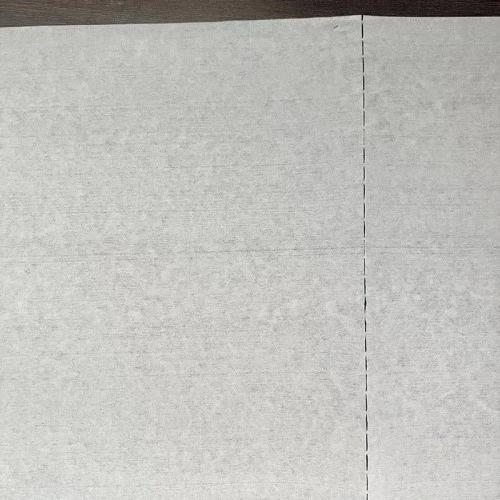
Structurally, mainstream products use a three-layer "sandwich" composite: wood pulp in the middle and synthetic fiber webs on both the top and bottom, with the whole assembly fed into a spunlace machine for reinforcement. The wood pulp is enclosed in the core layer and is not directly exposed on the fabric surface, which structurally suppresses linting; the core layer provides liquid absorbency, while the hand feel is determined by the outer fibers. The middle wood pulp is typically a blend of softwood pulp and hardwood pulp, formed through a pulp-forming process and sandwiched between two fiber webs. The long fibers on the two outer sides are selected according to end-use positioning: viscose or Lyocell can be used for skin-contact applications, while polyester/wood pulp composites are used when cost control is the priority. Fiber ratio is the first performance lever. In a polyester/wood pulp system, 55% wood pulp and 45% polyester is a common benchmark ratio; the polyhydroxy structure of wood pulp provides hydrophilicity, while polyester contributes strength and low-linting characteristics. The PP/wood pulp system places greater emphasis on oil absorbency and wet integrity, making it suitable for heavy-soil industrial wiping.
Spunlace pressure is the most critical process variable. Wood pulp loses strength rapidly when wet, so the hydroentanglement strategy must strike a balance between "sufficient entanglement" and "not excessive pulp loss." A common design is a gradient pressure profile: low-pressure pre-entanglement initially stabilizes the web and reduces pulp fly; medium-to-high-pressure water jets then impart sufficient energy to the polyester staple fibers to overcome the spatial potential energy barrier between fibers and form effective entanglement and bonding; pressure is then reduced in the later stages to densify the bottom layer, improve structural strength, and reduce surface fiber loss. Web uniformity also determines whether entanglement occurs consistently across the width. Cross-lapping combined with drafting is used to adjust the difference between machine-direction and cross-direction strength and improve basis-weight uniformity. If uniformity is insufficient, the entanglement efficiency of the high-pressure water jets in local areas will deviate from the design value, manifesting as a patchy appearance, strength variation, or excessive linting.
After entanglement, the web still requires drying and finishing. Wet wood pulp composite spunlace fabric can have a moisture content of 180–240% (dry basis). During drying, wood pulp fibers are prone to shedding from the surface; therefore, contact-type drying cylinders are often combined with rotary-screen through-air drying to achieve effective drying while reducing fiber shedding and maintaining softness. Finishing then adds hydrophilic, antimicrobial, or embossed functions according to the application.
In short, the performance of this material is not determined by the formula name "wood pulp + synthetic fiber," but is jointly shaped by the position of wood pulp in the structure, the fiber ratio, the spunlace pressure gradient, web uniformity, and the drying method. The "sandwich" structure addresses pulp protection and functional zoning, while high-pressure hydroentanglement addresses the physical bonding of two dissimilar fibers. Together, they form the process foundation for its use in wet wipes, medical dressings, and industrial wiping applications.